

The Workshop
“Dad, what about this?” Finlay said while directing me to look at the lug he was filing.
It was the summer holidays and I had encouraged Finlay to get up early and come help me in the workshop.
“That looks ok, but you need another pass with the fine file” I said.
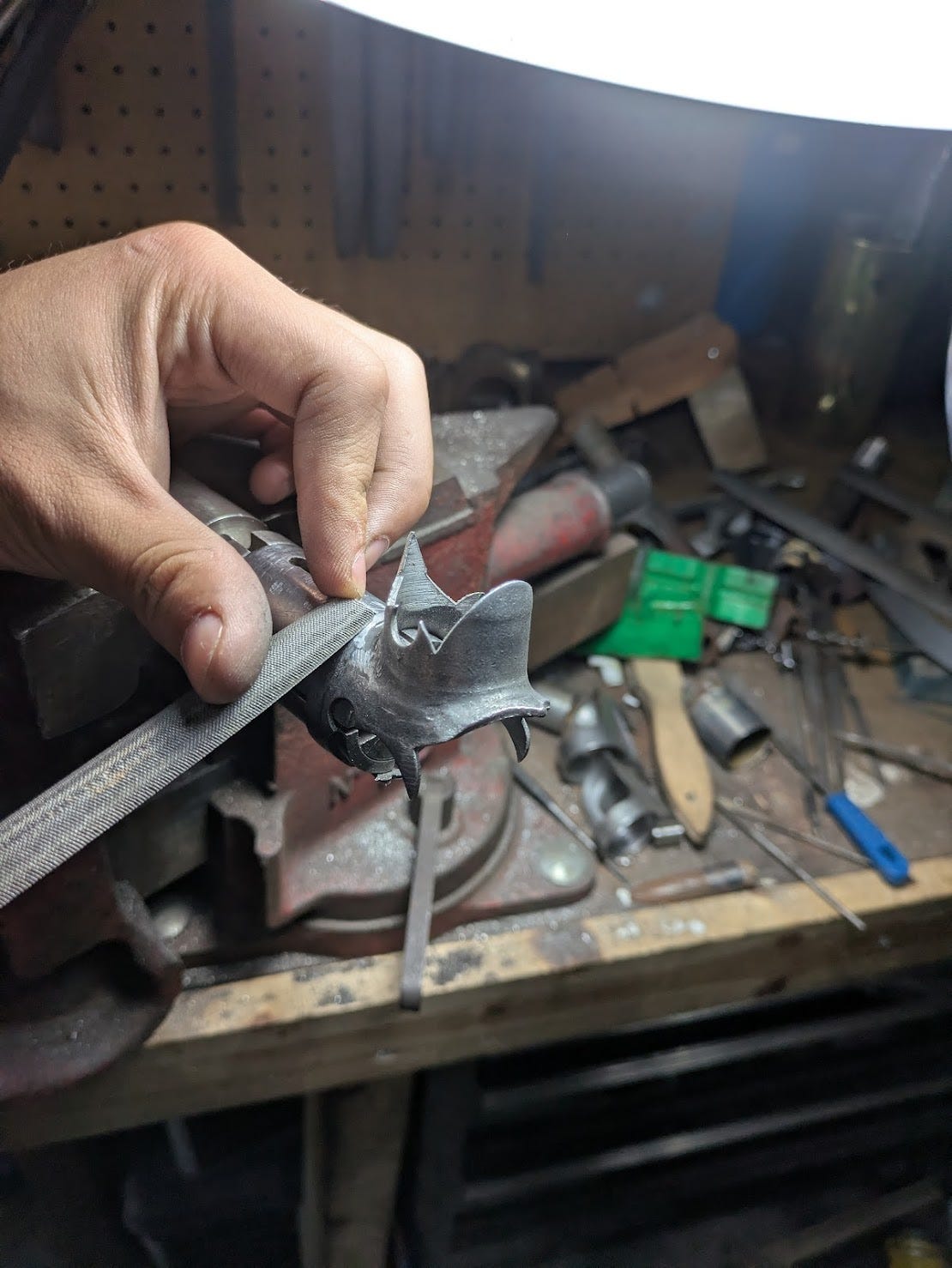
I thought to myself, “I am a lot more forgiving than Andrew used to be!” because my mentor would show me what was required, what it needed to look like and then leave me to it. Chastise me if it wasn’t good enough and if I asked to be shown again, he would say “I showed you that yesterday, weren’t you paying attention?”
Andrew didn’t exactly pass out compliments on your work, but if you were talking about the cricket scores or something rather than receiving condescension or contempt you were improving. A lot of apprenticeship is about formation in the apprentice and trust forming with those around you.
It must have worked though because I will never forget what he taught me or the standards he instilled.
Finlay and School
This month, my eldest son Finlay is taking his GCSEs. He stayed with me at the weekend and seemed quite calm about it all. Apparently it felt easier so far, than his mocks, which he did before Christmas.
This period in his life has kicked off some reflection about the same period in my own life 27 years ago. Finlay doesn’t really fit that well into academic life at school. He’s not disruptive or anything like that but he’s the kind of kid that teachers say has promise in some subjects, but doesn’t put in the required effort.
Thinking back to my own school reports there is definitely a parallel. And in other areas we are similar too. Finlay is practical, whether it’s helping me out in the workshop, or lending a hand when fixing my car, or buying broken electronics off eBay, fixing them and reselling them at a profit. But just like me, these kinds of things are barely recognised in school anymore.
It worries me that there are not really any good options for progression in his case. He’s likely going to come away with middling GCSE grades, but I really feel he could excel if he just had the chance to use his talents.
Coming from a career which is engineering adjacent, I can see that engineering would be a good career for him but the problem is that young people are just not exposed to this world anymore. He has me of course but I’m not a good representative of an engineering workshop, as I’m in a precarious and endangered craft.
I have been exposed to many of our remaining engineering workplaces over the years and they still need young people. I just genuinely think young people have no clue that they exist, how to get into these jobs or what the jobs actually feel like, once you’re in them.
The Disappearance of Practical Pathways
Young people are more perceptive than we give them credit for. They can tell that something is wrong with society and they are trying to make sense of it. The need to make money once they are in adulthood is obvious to them but they are often seduced by options that look good but where not many find success.
I think there is a thought in education that the “bright” kids will go to university and the kids left behind will just magically find their way into all these other practical jobs that we need. But we completely dismantled the routes into these practical jobs, and young people often don’t know what they are, nor can they see themselves doing them. It’s so important that the world is legible to them, especially when they have so many other influences.
The Workshop That Barely Made Anything
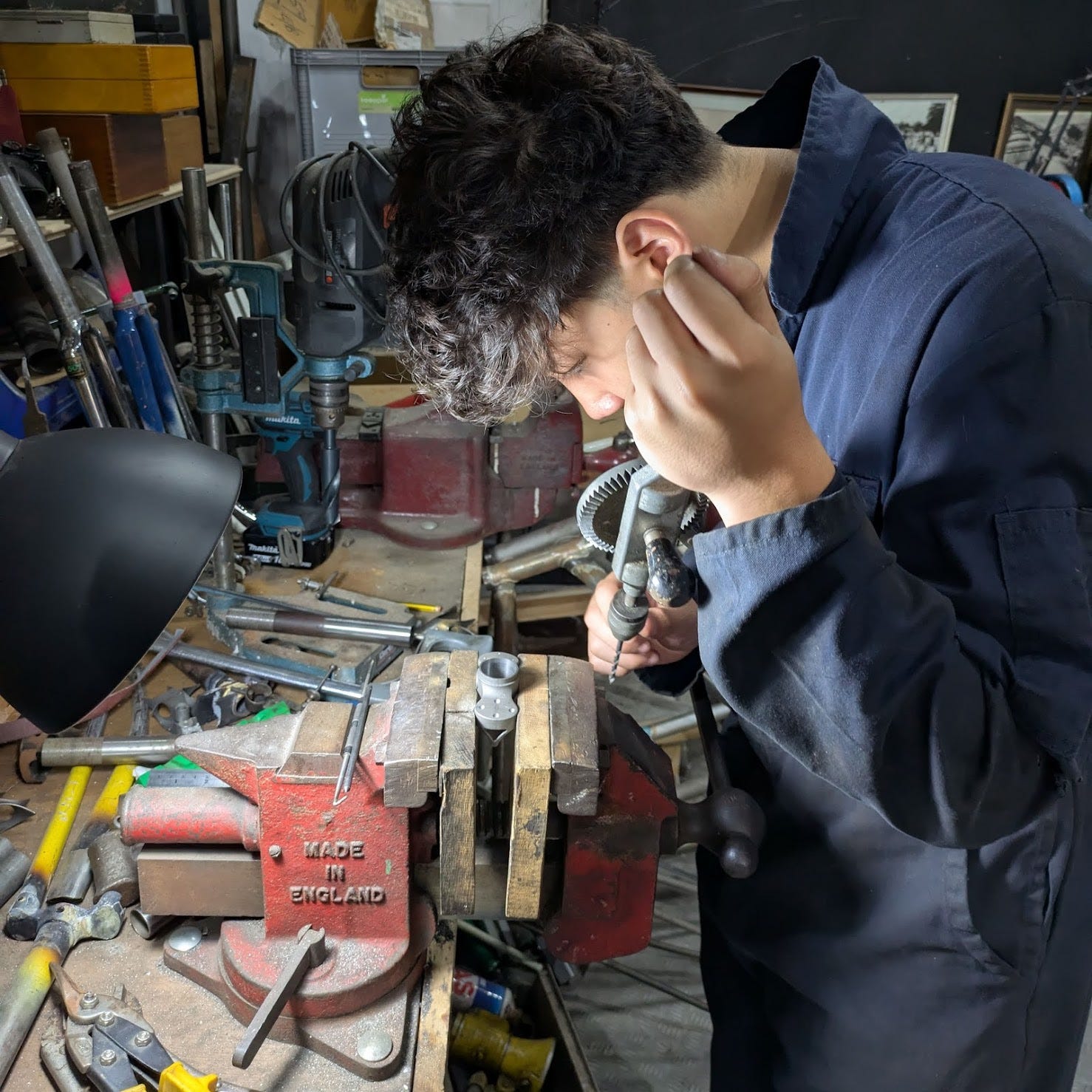
I’m obviously not a psychologist but from a young age I used to explore the garage at home. There were tools, bits of metal, a workbench, car maintenance items and other things. Some metal objects in there I didn’t understand until much later. I must have asked my dad, “what are these?” and he said “Oh, those are the machinists clamps I made during my engineering apprenticeship”. That one sentence carries a lot because my dad had entered engineering just as much of Britain’s industrial economy was being dismantled. I still have them in my tool box at work. They are very important to me because they symbolise a kind of continuity that nearly fizzled out.
It’s the same with my grandfather’s chisels and the stool he made that I sit on every day in the workshop. His father had been a stone mason but he had suffered badly with lack of employment in the 1930s and so had found another job as a school caretaker and he recommended my grandfather find something similar. I can only imagine that part of the reason my grandfather never became a stone mason is because his father had such a hard time in the 30s, he just couldn’t recommend it to his son and perhaps a thought that stone masonry had no future in modernity. But my grandfather always regretted not having a trade and it was the one thing he recommended my father did, “get a trade”.
I grew up around workshops, whether it was where my grandfather worked at an adult education college or the home workshop my dad had in the garage. I was practical from a young age and my grandad would make us wooden toys. He made me a small woodwork bench and I used to play with it when my dad was doing DIY.
When I was a bit older, I can remember walking down the corridor at a Nabwood Middle School open evening and being really excited when it opened up into an atrium that smelled of sawdust and machines. This was the woodworking workshop and I remember thinking, wow, I’ll be making something in there.
But the truth was, it was a relic from an earlier era and we hardly made anything.
Then later when I went to upper school, I was really excited about doing Design Technology. I thought I’d be making a chest of drawers or something, but I was in for a big let down when I realised it was mostly written coursework. The emphasis was on design, I guess it was decided that we weren’t going to lower ourselves to making things in Britain anymore, we would just design them.
But for me, I don’t know how to design without making? I have always liked to picture something in my head, perhaps do a rough sketch and then just make it. Which shouldn’t be weird because most of the engineers during the industrial revolution were iterative makers.
In those three years leading up to my GCSEs, one lesson stands out. But before I get to that, I should tell you another story that happened years later.
In my early twenties I used to help my friend Ste work on his Land Rover. It would be the middle of winter, snow on the drive, and I’d be lying on my back underneath the thing on a bit of old carpet, trying to hold the exhaust while Ste undid the bolts. We kept the cold at bay with endless cups of tea and old winter jackets thrown over our overalls.
That world introduced me to some interesting people. One was an apprentice mechanical engineer called Mark. His dad ran a small engineering workshop in Keighley called John S Feather Ltd, and sometimes we’d spend Saturday mornings there messing about making things.
At one point I had some ridiculous idea about building exhaust manifolds we could sell, so we started trying to fabricate the parts before welding them together.
Mark was a larger than life character. Ste had met him through work and they bonded over cars and motorcycle trials. It turned out his dad also knew Ste’s dad. He drove a Vauxhall Astra van with an absurdly loud exhaust.
One day we were making something, I think it was a mechanical tube bender, and I needed to cut a thread into a hole we’d just drilled. Mark and Ste stood watching while I started the tap into the hole. I think they were expecting me to snap it and ruin the piece. They were already preparing to take the piss out of me.
But what they didn’t know was that years earlier, during one DT lesson that somehow stuck in my mind, I’d been shown how to use a tap and die properly.
Half a turn forwards, quarter turn back. Repeat.
I still remember it.
They looked almost disappointed when the thread came out perfectly fine.
And I think that says something important.
In three years of upper school, with almost no meaningful practical education at all, one small piece of instruction had stayed with me for years afterwards and resurfaced naturally the moment I needed it.
What a missed opportunity that was.
Mark and the Legible World
Mark is an interesting case because his father had sent him to Fives Landis, a large local engineering firm where Ste also worked, to do his apprenticeship before eventually returning to the family business.
That used to be fairly common. Small firms often didn’t have the capacity to train apprentices entirely in-house, so larger engineering firms or nationalised industries filled that educational role.
For Mark, this world was never invisible. It was legible to him and, more importantly, prestigious from a young age.
His dad’s workshop was full of machinery and around half a dozen skilled engineers. These kinds of firms don’t churn things out. Nearly every job is bespoke, whether it’s making parts to keep old farm machinery running or building custom machines to face stone bricks.
It must have been entirely obvious to a young Mark that his dad was highly intelligent in a practical way, and so were the men who worked there.
My dad used to take me and my sister to work with him occasionally when he needed to go into the office on a Saturday morning. So I had early exposure to a modern open-plan office, full of computers and workstations.
To be honest though, I was more interested in the coffee machine and trying to make myself a coffee without putting fifteen sugars in it.
I think my dad hoped I might get an entry-level job at the building society and work my way up, much like he had done. It has given us a good life after all. But if I’m completely honest, it never really appealed to me. I was far more interested in the wood workshop my grandad had shown me all those years before.
I hope my dad doesn’t mind me saying this, but if he’d had an engineering workshop like Mark’s dad, I don’t think I would have struggled to find my way in life.
My Father and the Broken Chain
My father had done an engineering apprenticeship and ended up working as a draughtsman at a gearbox manufacturer in Bradford. But after only twelve months he was made redundant during the early 1980s decimation of our industrial economy.
During the bad winter of 81-82 my dad sold the car and was reduced to shovelling snow, while my mum, who was heavily pregnant with me, carried the weight of the family and the mortgage. She worked in the accounts office at Grattan catalogue and had to walk to work from our house in Lidget Green. On one particularly bad day her boss was astonished that she’d come in and sent her home.
We got through this precarious time though and my dad managed to retrain in IT. He first retrained as a COBOL programmer and worked at a local firm before he got a job in business systems at Skipton Building Society.
Looking back I can see we were lucky. There were still opportunities for someone like my dad in Bradford, other areas were not so fortunate.
My dad had seen engineering become unstable almost overnight. So although he still had practical instincts and kept a workshop in the garage, I don’t think he ever really steered me towards engineering as a career.
And because of that, engineering felt strangely absent while I was growing up in the 1990s. Which is odd really, because the Aire Valley was still full of small engineering firms quietly making things, repairing machinery and keeping industry running. But culturally, it already felt like part of an older world.
So a bit like my son now, I wasn’t really sure what to do after my GCSEs. I don’t think I enjoyed school very much. I didn’t hate it, but if I’m honest, very little of it truly engaged me.
Generic Smartness
Even engineering as a degree was never talked about, and I was a kid who was relatively good at maths and science, and wanted to make things. It’s bizarre really. Engineering was seen as part of the old world and it wasn’t the future.
But the weird thing is there was no education in computers either, the other area I was interested in. Like many people I self-taught how to code because it wasn’t taught at school and this reminds me of Finlay teaching himself to repair electronics. Because there is no outlet for this kind of thing in our education system.
At Finlay’s school they have a room of 3d printers, that he says he never used? And why did he not get taught something like 3d modelling in solidworks? I just don’t think we even attempt to engage kids that are not academic or at least not consistently.
Matthew Crawford writes about an education culture of “generic smartness”, where students are deliberately not encouraged to specialise too early. Looking back, I increasingly wonder whether this leaves many practically minded young people disconnected from anything concrete at all.
Work Culture and Formation
At Christmas I did a series of Facebook posts on deindustrialisation and had an amazing response from people, including lots of conversations about what taking on young people looks like now.
I would get comments like, “they can’t stand up all day”, “they are always on their phone” and even “I had to show them how to use a sweeping brush”. Others told me that they tend to look for young people now that have other interests, a bit like how I messed around with Land Rovers with my friend.
But that relied on the fact that I was lucky enough to have that opportunity and my friend’s dad had a garage and shed full of tools and a love for classic motorbikes and Land Rovers.
We just can’t rely on those things for our next generation of practical people.
It made me think that not only are young people never introduced to a workshop anymore but also they are not socialised into anything like a work culture either.
What do you want to be when you grow up?
I was talking to my 6 year old on the way home from school yesterday, we got talking about this and his first answer was YouTuber (I don’t even let him watch YouTube!), his second answer was toy designer, which felt much better. But what jobs are we actually making legible to children? Finlay has also been through times where he wanted to be a YouTuber, and in September he plans to start a course in E-Sports.
I think my own connection to a broken lineage is what drives me to bring dignity back to working class crafts and trades and why I feel my own adopted lineage within British framebuilding culture is so important.
Looking back, I can also see how lucky I was to have the space for those experiences. My dad had managed to build a stable life for us after a very precarious start and many of my friends’ dads had garages, sheds, workshops or practical hobbies of their own. We had room to explore things, make mistakes, build confidence and slowly learn how the material world worked.
Without those experiences I honestly don’t know where I would have ended up.
And I think that is really the point I’m trying to make.
As life has become more precarious and poverty has grown, we have simultaneously removed many of these same experiences from our education system and wider culture. Yet we still depend on people who engage with the world in this way.
We take them for granted because when practical work is done well it often becomes invisible. But look around. Everything in the built world has to be made, repaired, installed, maintained and understood by somebody.
And the knowledge required to do that is not something most people learn abstractly. Just as I slowly realised growing up, you learn by doing. It takes time. It is often slow, difficult to standardise and hard to credentialise. But it also produces capable, thoughtful people who understand the consequences of their actions and quietly maintain the world around us.
I think my own connection to this broken lineage is part of why preserving craft and practical culture feels so important to me now.
This brilliant piece captures something that rarely gets discussed properly: the disappearance of practical culture as a pathway into adulthood. The point about “generic smartness” is especially strong - schools increasingly reward academic performance while treating practical intelligence as secondary, even though society still fundamentally depends on people who can build, repair, maintain, and understand material systems.
What comes through most clearly is that this is not just an economic issue but a cultural one. Workshops, apprenticeships, sheds, garages, and informal mentoring once made the world legible to working-class kids in a concrete way. As those environments disappeared alongside deindustrialisation, many young people were left without any clear route into meaningful practical work at all.
The detail about remembering a single lesson on tapping threads years later says a lot. Practical knowledge often sticks because it is embodied through doing rather than memorised for assessment. The tragedy is that schools increasingly removed exactly the forms of education that might have engaged students who think in that way. Well-written!
What's the name of the engineering workshop in Keighley? Was any of it related in anyway to Kone?