
Why Doesn’t This Advice Work Anymore?
Why advice that once worked for young people no longer matches the world they face today

A brief note before this week’s essay.
I’ve struggled to quiet my mind enough to write over the past couple of weeks. Even reading has been difficult, so I’ve done what I often do when life feels overwhelming and buried myself in the workshop.
This year has been something of an emotional rollercoaster, both personally and in running a small craft business. Over the last few years, I’ve come to realise just how much our emotions shape our ability to think, work and create. I used to believe that emotions were simply something that lived in my head and that I could overcome them through sheer willpower. I no longer think that’s true. In fact, it hardly even feels like a revelation. It seems so obvious to me now that I’m almost embarrassed I didn’t understand it sooner.
I’ve learnt that sometimes I simply can’t do certain things and that I shouldn’t feel guilty about it.
So this essay has taken rather longer to write than usual.
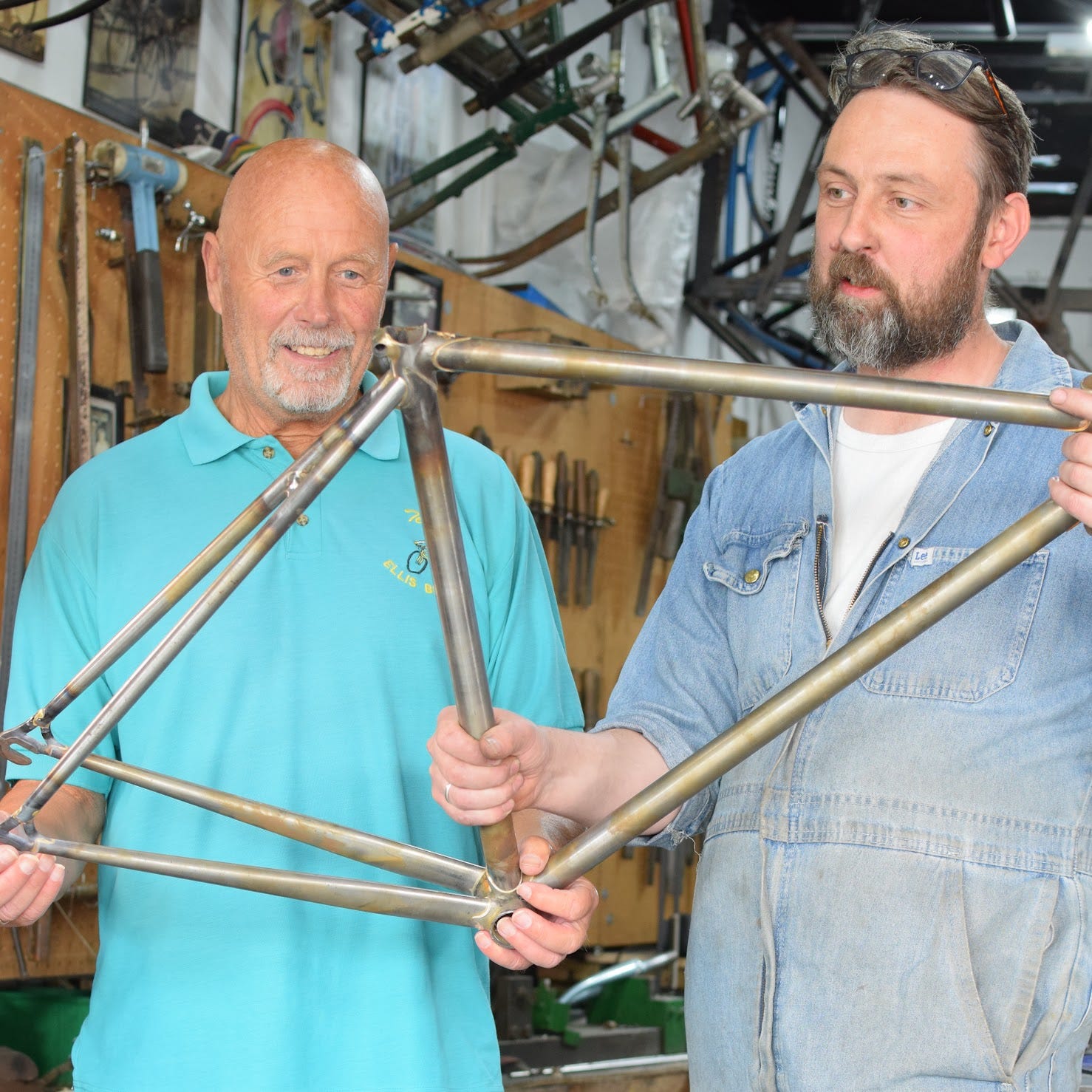
Why Doesn’t This Advice Work Anymore?
“Just print out a CV, walk down your local high street and apply for jobs directly.”
This is the kind of advice often given to young people who are struggling to find work after applying for hundreds of jobs through online recruitment systems. It reminds me a little of Norman Tebbit’s famous advice to the unemployed: “Get on your bike.”
The problem is: apply where?
A vape shop? A mini mart? A bookmaker? A charity shop? A barber?
Back in 2000, when I was entering the job market, I sat in my parents’ hallway with the Yellow Pages and started ringing bike shops.
Thinking back, I can’t even remember how many I called.
After a couple of calls, I heard a line that would become familiar to me every day for the next fifteen years.
“Hello, Ellis Briggs Cycles, Shipley?”
It was always spoken as a question. A sort of, yes, you’ve got the right number, how can we help?
I think it was John Briggs who answered that day.
I asked if they had any jobs.
As it happened, somebody had recently left.
They were looking for someone.
Would I like to come in for an interview?
Within a week, I had a job.
Today, politicians and commentators still give young people essentially the same advice. Walk into businesses. Hand over a CV. Show a bit of initiative.
What strikes me is that the advice assumes an economy that no longer exists. I’m sure you could still find exceptions where it works today, but the opportunities feel much rarer.
Thinking back, what stands out to me is how ordinary my experience was. It wasn’t remarkable. It was simply a normal way of entering the job market and starting adult life.
The job wasn’t particularly well paid. I always had to work Saturdays, and occasionally Sundays too. But I had a contract, full-time work and a regular income.
The work itself was varied and interesting. The shop was full of characters. There was a sense of community. Most importantly, I was learning something. Every week I knew a little more than I had the week before.
Of course, bicycles were also my hobby. Looking back, I was incredibly fortunate.
But I don’t think I was unusually fortunate.
I think I was benefiting from an economy that still contained large numbers of small businesses willing to take a chance on a young person.
Today, many young people find themselves moving between warehouse work, delivery driving, agency shifts and zero-hours contracts. The work may pay the bills, but it rarely offers the same sense of direction. It is difficult to build a career when you are never quite sure whether you will have work next week.
That, perhaps, is the real difference.
The question is not whether young people want to work. It is whether we have left them enough pathways into stable and meaningful work in the first place.
We’ve operated for a long time on the assumption that if a business model no longer works because a larger, scaled-up version can do the same thing with fewer staff and lower costs, then that outcome is as natural as gravity.
We even have a phrase for the advantage that large businesses enjoy: “economies of scale”.
But have we defined many small businesses too narrowly?
A baker produces bread. A butcher cuts meat. A bike shop sells bicycles.
Once we define them in these terms, their replacement appears inevitable. If a larger organisation can perform the same function more cheaply, then it seems rational that it should prevail.
Yet this starts to resemble what Rory Sutherland calls the “doorman fallacy”.
Imagine a hotel with a doorman. A consultant arrives and defines the doorman’s purpose as opening and closing the door. Having identified the function, they propose a cheaper solution: an automatic door.
The hotel saves money. The consultant gets paid. The spreadsheet looks better.But the hotel may also have lost something important.
The doorman wasn’t merely opening doors. He was greeting guests, providing reassurance, offering directions, recognising regular customers and helping create an atmosphere that justified the hotel’s premium status in the first place.
The mistake was not replacing the doorman. The mistake was defining the doorman too narrowly. I increasingly wonder whether we have made the same mistake with many small businesses. The baker does not simply produce bread. The butcher does not simply cut meat. The bike shop does not simply sell bicycles.
They employ people, train apprentices, build relationships, create community, pass on skills and help form the social fabric of a place.
Once those functions are excluded from the definition, their disappearance appears rational.
The question is whether we have been measuring the right things.
Once the baker, butcher and bike shop are no longer viable business models, what do we expect our high streets to look like? And where does a young person go to hand over their CV?
If we look around our towns, we can see this process everywhere. Supermarkets have replaced many of the smaller food businesses that once occupied our high streets. Independent bookshops, pet shops and specialist retailers have become much rarer, particularly outside affluent areas.
I’m not suggesting we should get rid of supermarkets. They provide genuine benefits. Food is cheaper, choice is greater and supply chains are remarkably efficient.
But perhaps we have allowed scale to become the only measure by which we judge success.
In doing so, we may have lost more than we realise.
My wife is Greek, so I’ve spent a considerable amount of time at her parents’ home in Athens.
One thing you notice when spending time among Athenians is just how normal it is to use small local businesses. They have supermarkets, of course, but they also have a web of butchers, bakers, hardware shops, bike shops, greengrocers, cafés and countless other independent businesses woven into everyday life.
In many neighbourhoods, almost everything you need is within a few minutes’ walk.
What strikes me is that nobody regards this as unusual.
It isn’t a political project.
It isn’t a heritage initiative.
It isn’t an attempt to turn back the clock.
It’s simply normal.
That’s why I’m sceptical when people suggest that the disappearance of small businesses is somehow inevitable. We are often told that scale, consolidation and centralisation are simply the natural direction of economic progress.
Yet there are modern, developed countries where a much more plural economy still exists.
The question, then, is not whether such an economy is possible.
The question is why we have made it so difficult to sustain.
This raises a deeper question about the kind of efficiency we actually want. Efficiency at producing the cheapest possible goods? Efficiency at reducing labour costs? Efficiency at maximising profit? Or efficiency at creating prosperous and resilient communities?
A supermarket meat counter can sell vastly more meat with fewer people than an independent butcher. That’s undeniable.
But if the butcher employed local people, trained apprentices, kept money circulating in the local economy and provided a visible path into skilled work, have we fully accounted for what was lost?
Those things are harder to measure than profit margins. Yet they may matter just as much to the long-term health of a society.
I’ve met a surprising number of bike shop owners over the years. Some were ruthless business people, but many had other motivations. In fact, it was something of a joke within the trade that many shop owners treated it as a hobby rather than a job.
Suppliers tended to view this as unprofessional. I used to agree.
Now I’m not so sure.
Most of these people weren’t trying to build the next multinational corporation. They wanted to spend their days around bicycles, earn a decent living, support their families and be part of a community they cared about.
Of course, small businesses are not automatically virtuous. I’ve known bike shops that were badly run and others that treated staff poorly. But the same can be said of large businesses. The question isn’t whether one is morally superior to the other.
What struck me after twenty six years in the bicycle trade was that most bike shops were run by decent people trying to make a living doing something they cared about. They varied enormously in quality, but precisely because there were so many of them, they had to compete. They competed for customers, for staff and for reputation. They differentiated themselves through service, knowledge and personality.
If we apply modern business logic to them, would it recognise the value in these small businesses? Or would it simply conclude that they are inefficient? If a business builds a community, spends time talking to customers, supports local clubs and gives back to the culture that makes the business possible, are those things merely sentimentality? Or are they part of what makes an economy and a society worth having in the first place?
If we replace hundreds of local bike shops with an efficient warehouse and parcel delivery network, are we not committing the doorman fallacy ourselves? We have defined the bike shop’s purpose so narrowly that its replacement appears obviously rational.
If the function of a bike shop is simply to move bicycles and components from one place to another, then the warehouse wins easily. But bike shops also trained mechanics, employed local people, supported clubs, shared knowledge and introduced countless people to cycling in the first place.
By treating those things as incidental, we risk giving primacy to a very narrow idea of efficiency while ignoring much of what these businesses actually did.
I think in terms of bike shops because that’s the world I’ve been embedded in for the past twenty six years. But I increasingly suspect the same questions could be asked of much of small business.
Suppose the supermarket saves us all twenty pounds a week on our food shopping. But in doing so, it reduces the number of independent businesses, apprenticeships and secure jobs that might otherwise exist. Suppose it diminishes some of the local institutions that provide pathways into work, places of belonging and the social fabric of a neighbourhood and replaces them with fewer, more precarious forms of employment.
Then perhaps the person who says, “I need cheap food and convenience because I work long hours and can’t afford to pay more”, is not simply responding to the economy. Perhaps they are also, at least in part, a product of the way we have chosen to organise it?
If, twenty six years ago, I’d opened my Yellow Pages and found only national chains, rung them up and asked if they had any jobs, would I have found work so easily? Or would I have been in the same position as many young people today, endlessly filling in online applications and hearing nothing back?
And if the answer is the latter, we should perhaps ask ourselves a more uncomfortable question. Is that really the world we want to build?
Excellent essay asking the right questions. Have you read Edward Bellamy’s book, “Looking Backward: 2000 - 1887”, published in 1888?